When we began 2020 I thought the big event of 2020 would be a personal one: turning 60. I reflected on my life – now most certainly past any “mid” point – and wondered what the years ahead would bring. I revisited a birthday blog I wrote in 2018 in which I reflected on the generally-taboo topic of Death.
It turned out that my February birthday celebration was the last “normal” thing I recall. I took an amazing boat ride out to Santa Cruz Island with my kids, then had old and new friends over to my house to write “get out the vote” letters that I saved until October to mail. 
That’s the last clear memory I have of sharing food and drink in a crowded room without worrying that standing too close and simply breathing could lead to someone’s death.
A few weeks later, the world turned upside down. The great taboo topic of Death became harder and harder to ignore. (But somehow, most people managed to ignore it anyway.)
When the pandemic first began, I read many thoughtful, philosophical essays and blogposts about the lessons that Mother Earth, the universe, God or the goddesses seemed to be trying to teach us. I wrote a few myself: about the opportunities that this crisis presented for seeing the social world in new ways and for re-imagining it; about the contradictions we were all suddenly living; about what it would mean to really, truly, deeply appreciate what we have right now, by embracing “the cups already broken” – the fact of our impermanence.
I joined a chorus of people who focused on what we might take from this experience: Slow down. Be more present. Be grateful for each moment, each connection we have with our loved ones, each breath. Re-evaluate our priorities. Drive less, consume less, produce less, and BE more.
But then those lessons seemed to fly out the window, as we – especially those of us in Academia – ramped up. While Death was all around us, we acted as if we were invincible. While the plans of the whole world got derailed, we just kept chugging along the same train tracks. We got schools on line, meetings on line, everything on line…and we taught more or less the same lesson plans we would have, because we were worried about keeping everyone “on track.”
On track to what?
Admittedly, I ramped up my own work this year by taking on a whole new project: a study of the impact of the pandemic on 33 households across the country, part of a study of households in ten countries around the globe.* While this added significantly to my work load, it also helped me to slow down. Reading the diaries of our participants, I and my research team (Dr. Priscilla Liu and Sophia Ángeles) cried and laughed and heard the lessons our participants were learning this year. While not all their words were hopeful – some expressed great despair, and cynicism – I was struck by how many seemed to be learning profound lessons about what really seems to matter in life. Here are a few excerpts:
“Things that mean more to me now: a warm hug, a belly-laugh with my girlfriends, our little apartment with a window full of green leaves that blow in the breeze, the peaceful crash of waves at the beach, an evening stroll in the neighborhood, a freshly-baked slice of banana bread, a drive up the coast, Thai take-out, and smiling eyes peeking out from behind a face mask. Simple, beautiful things that fill my small days with happiness.”
“I was able to appreciate spring this year. Since we were home most of the days, I was able to see the leaves and flowers grow. It’s like time stood still.”
“I have learned to be grateful and take nothing for granted.”
“We’re learning that patience and grace are imperative.”
“This time together is a blessing, and no matter what challenges come with this pandemic, I hope to forever be grateful for this time together.”
“This pandemic has taught me to make the most of a bad situations.”
“What an increase in awareness I now have on the freedom and privileges I have taken for granted in life!”
“Living with gratitude in my heart is the single easiest and most gratifying way I know of that grounds me in the moment and allows me to see the blessings manifest in my life and in the lives of my loved ones.”
“Without love, this pandemic is just a thing that brings disappointment and despair.”
As we launch 2021 I’m hearing lots of platitudes like: “It has to get better.” But does it? I don’t think the universe works by simple rules like that. Unless by “better” we mean the things we have power to change – which is probably, mostly, or only, the way we view things, what we do with what we get, and how we respond to whatever comes our way.
***
As for my own New Year’s resolutions? Through the years, I have written countless lists for self-improvement. I’ve also made commitments to the world – ones I revisited today, and stand by, because accepting things as they are doesn’t mean we can’t, simultaneously, take action to forge a better world. We can help the arc of the universe bend toward justice.
But mostly, this year, I hope to be a little less “resolute.” Google’s on-line dictionary defines resolute as “purposeful, determined, and unwavering.” Instead, I hope to be more flexible, adaptable, present, and ready to respond thoughtfully to whatever comes up.
Because really, who knows?
Maybe that’s the real lesson that 2020 can teach us. To get a little better at responding rather than reacting. To recognize that “better” is what we make it. To see the cups we hold right now as already broken so that we treasure them now, while we have them, all the more.
*The project was funded by grants from the Spencer Foundation, the UCLA Bedari Kindness Institute, and the Social Science Research Council.

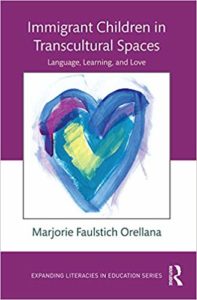
 As with the other chapter summaries, it is set to music composed by Andrés Orellana (Abstract Apathy).
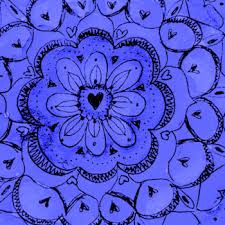

 I enlisted my children’s artistic talents not just to support them as emerging artists, and not just because I’m a “proud mama” (though I am), but because despite our very different approaches (Elisa via theatre, storytelling and visual arts; Andrés via music; I via research and writing), we have much in common. We have influenced each others’ thinking and ways of being over the year. For sure, my kids have learned some stuff from me, but I have also learned from them in substantive and important ways. They really have been some of my greatest teachers, and my own ways of seeing, thinking, doing, and being have been enriched through our extended, informal, family collaboration. I also share their art and music as a way of balancing the heady or “mind”-centric nature of academic writing with more heart-centered stances. As you listen to my words, you can rest your eyes on the beautiful image Elisa created, and imbibe the gentle background music Andrés performs. Academic reading doesn’t have to be onerous. And academic work doesn’t have to be boring. It can be a creative, spiritual and aesthetic experience that connects our minds and bodies and anchors us in the world. I hope you will enjoy!
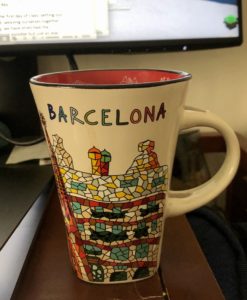 “You see this goblet?” asks Achaan Chaa, the Thai meditation master. “For me this glass is already broken. I enjoy it; I drink out of it. It holds my water admirably, sometimes even reflecting the sun in beautiful patterns. If I should tap it, it has a lovely ring to it. But when I put this glass on the shelf and the wind knocks it over or my elbow brushes it off the table and it falls to the ground and shatters, I say, ‘Of course.’ When I understand that the glass is already broken, every moment with it is precious.”
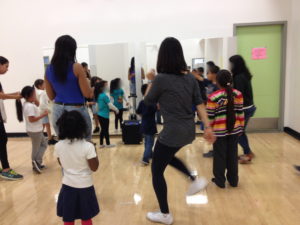 Now, I smile at video clips of those days, as our team gathers in a Zoom Room to analyze the embodied nature of learning. I relish the connections we are managing to sustain with the kids in our program, through letter exchanges, Remind App messages, and a new and interactive web page. Not the same as playing together, but precious just the same.
 …Running with friends along the beach path on moonlit winter nights. (I hated wearing a headlight and couldn’t wait for daylight’s saving.) Cheering these loyal friends on, as they pounded with thousands of others through the streets of LA in March’s marathon, right before that cup broke. Now, I treasure the daily texts my running friends send, posting photos of their solo routes on empty streets, reports on distances and times; and I cheer them on in a strange new thing called “virtual races.” I am learning to run alone again, breathing in city air that is miraculously clean.
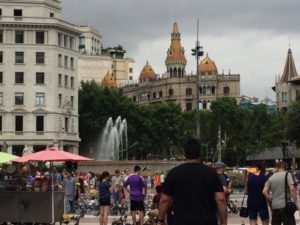 The trains and planes and buses that took me there, filled with people going somewhere, oblivious to the privilege of this movement across borders, ignoring the passengers beside them or greeting them with a nod, a smile, or friendly banter, not with fear of the invisible enemy that could spew from their mouths or the pores of their skin and silently spread. All the crowds I have pushed through and the queues I have stood in with aching feet and grumbling mind. I cherish the broken cups of these memories, and embrace the six-foot-spacing-to-buy-toilet-paper-queue that is in the cup I hold right now.

 y and terror, hope and fear, love and anger, humor and horror, joy and grief. I see the best and worst of humanity, and both dread and relish what could lie ahead.


 My ulterior motive in writing Mindful Ethnography was to share some of the lessons I have learned about life in general and academia in particular, by working through my own health crises and an extended healing process. (See my previous blog.) I wrote it with my younger, anxiety-filled, angst-ridden school-girl self in mind, filling it with reassurances for young scholars entering this business, and calls to let go, as best we can, of our fears, worries, plans, hopes and expectations. We are being forced to let go of many plans right now.
 This is not a time to go about business as usual. My heart goes out to the many doctoral students who cannot pursue the projects they have planned for some time – like my own protégé, Sophia Angeles, who was poised to begin her dissertation research this spring, doing participant observation in a Los Angeles high school, to explore the experiences of undocumented, “unaccompanied minor” adolescent youth. Gaining access to this population will be much more challenging now.
 At some point you may be ready to turn your mind in some new directions. And there are very new, important questions that are emerging. Identify the ways this global pandemic impacts the questions you had planned to explore, or were already exploring. For example, in Sophia’s case: How are unaccompanied minor adolescents in the U.S. being affected by COV19 in particular ways? How does the pandemic influence their social, emotional, health and well being, as well as their ideas about possible futures? What access do they have to health care, and how are their families and communities being impacted? And how are they making sense of this experience?
 losses in our immediate and long-term futures. It may take time, even beyond the immediate crisis, to process and heal; and new crises may be looming. Both individually and collectively we will likely experience many emotions. Allow for it all, and don’t try to rush to resolution. Slowing down and really feeling whatever comes up for us can be the best thing to do during times of tremendous uncertainty. Just trust that if we ride the waves, we will get to a clearer place where we will be able to really appreciate the lessons that are there to be learned.
 this to raise fears, only to see as clearly as we can what is in front of us, so we can make more conscious choices, as the CoVID19 is helping us to do now.
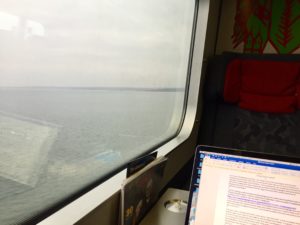 On this pre-Thanksgiving travel day, I am riding a train from Copenhagen to Amsterdam – opting for ground travel rather than a much shorter plane ride, as my small contribution to reducing my overly large carbon footprint. I love traveling this way: seeing the land stretch out before me, mingling with locals, hearing the sounds of multiple languages, feeling the distances between points that are eclipsed in the air. Plus train travel offers undistracted time for reflection and writing.
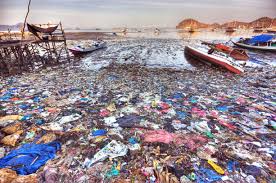
 I don’t think I’m brave or enlightened enough to set myself on fire. I’m not sure I’ll ever be courageous enough to voluntarily “check out” of life. And while I believe deeply in the equitable sharing of resources – not just a political stance, but one that was strongly enculturated by growing up in a family of ten people – I also recognize that even in an ideal world all resources can never be distributed with complete equity. We can strive to make things fair for others, but in the end, we each get what we get, of both tangibles and intangibles, such as our share of beauty, intelligence, love, belonging, and connection.